
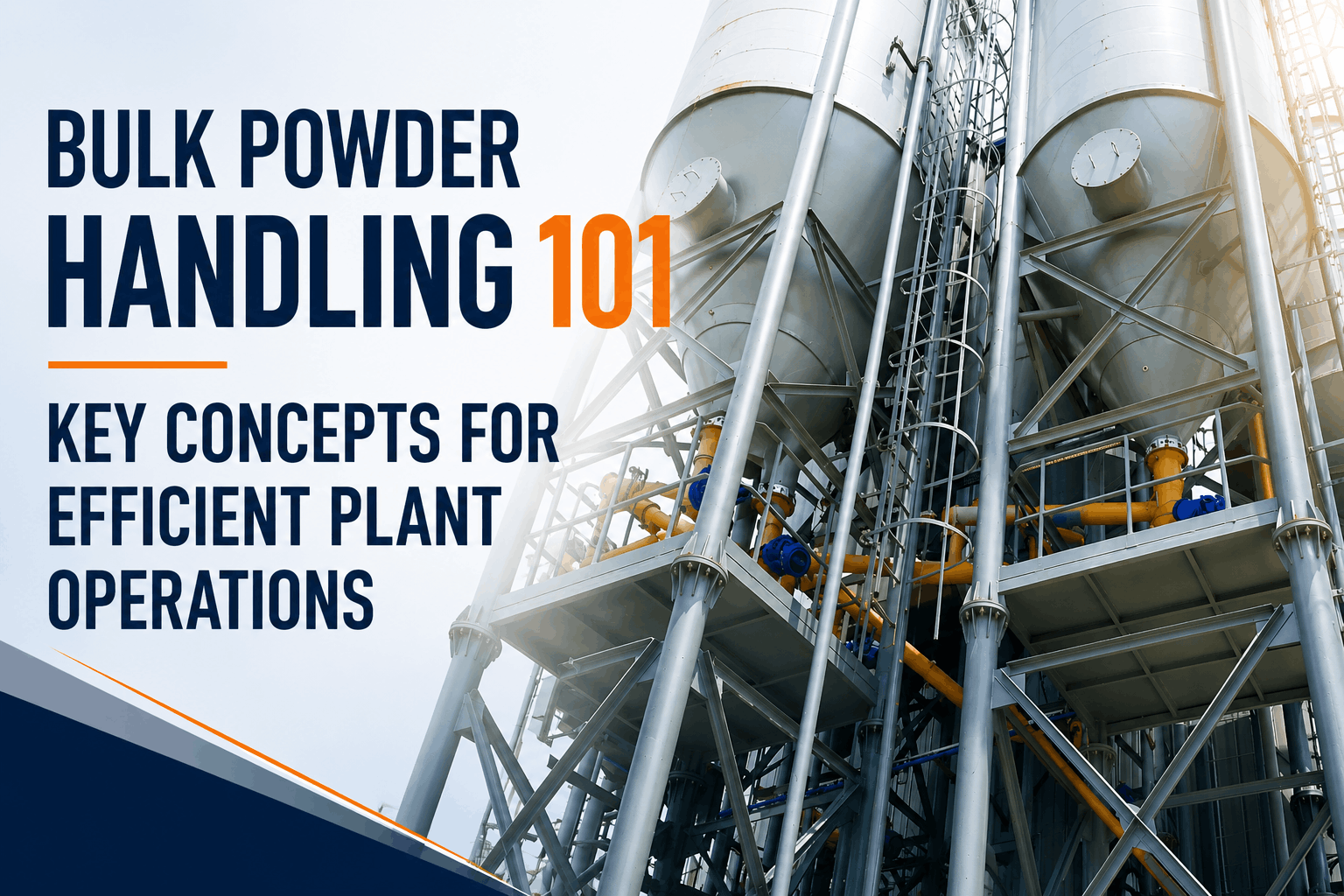
Bulk Powder Handling 101: Key Concepts Every Manufacturing Plant Should Know
Bulk powder handling is not just about moving material from one point to another. Every powder behaves differently, and understanding these characteristics is the foundation of designing bulk powder handling systems in manufacturing plants.
Understanding Powder Characteristics in Bulk Handling
Every powder has its own unique characteristics, defined by parameters such as particle size, bulk density, moisture content, abrasiveness, flowability, corrosiveness, and cohesiveness. These properties directly influence how a material behaves during storage, conveying, and feeding.
Fine particles often exhibit poor flow and generate excessive dust, while coarser granules generally flow better but may segregate. Bulk density impacts equipment sizing and structural loads, while even small variations in moisture content can transform a free-flowing powder into a sticky material prone to bridging and rat-holing. Abrasive or corrosive materials can significantly reduce equipment life if not handled correctly.
For example, a plant handling lime powder experienced frequent feeder blockages after the rainy season. The only change was a slight increase in moisture content during storage, which caused bridging in the hopper. Once identified, simple measures such as modifying the hopper geometry and providing air conditioning to the feed area restored reliable flow. This illustrates how minor changes in powder properties can have a major impact on bulk material handling performance.
Learn more about our Engineering Capabilities
Impact of Material Properties on Equipment Selection
Material characteristics directly influence the selection and design of bulk material handling equipment.
Storage systems such as silos, bins, and hoppers must be designed to promote mass flow wherever possible. Conveying systems - including screw conveyors, pneumatic conveying systems, and bucket elevators - transport material between process stages. Feeding equipment, such as volumetric feeders and loss-in-weight feeders, controls the rate at which powder enters the process and is critical for maintaining product consistency.
Dust control systems, including bag filters and dust collectors, protect both personnel and equipment by capturing fine particles released during material transfer.
A key principle in bulk powder handling is that equipment must be designed as a system. A well-designed feeder cannot compensate for a poorly designed hopper above it, and an oversized dust collector cannot correct excessive dust generation caused by poor transfer point design.
Explore our range of Conveying & Feeding equipments
Fundamental Principles of Good Bulk Powder Handling Design
Effective bulk powder handling systems follow a few core engineering principles:
- Design hoppers and outlets to suit the material, rather than relying solely on standard drawings. Wall angles, outlet sizes, and surface finishes must be based on measured flow behavior.
- Avoid stagnant zones that promote material buildup, segregation, or degradation.
- Control dust at the source by minimizing free-fall heights and using proper enclosure and extraction systems.
- Consider operation and maintenance, including how the material will be loaded, unloaded, cleaned, and inspected over time.
Applying these principles early helps prevent many common issues seen during commissioning and long-term operation.
Explore our range of Discharging equipments
Safety and Hygiene in Bulk Powder Handling
Beyond efficiency, safety and hygiene are critical considerations in bulk powder handling. Dust accumulation can create explosion risks, slip hazards, and maintenance challenges. Proper grounding, explosion protection systems where required, and effective dust collection are essential - especially in classified or hazardous areas.
Clean transfer points, good housekeeping, and accessible layouts allow operators to safely inspect equipment and intervene when needed. Designing with safety in mind not only protects people but also improves long-term plant reliability.
The Importance of Early Collaboration with Equipment Suppliers
Successful bulk powder handling projects depend heavily on collaboration. Sharing accurate material data, process requirements, and layout constraints early in the project enables realistic equipment design and smoother commissioning.
Treating equipment suppliers not merely as vendors but as engineering partners helps identify potential issues before fabrication begins. Many common powder handling problems can be avoided when engineering teams work together before any steel is cut.
Why This Matters for Manufacturing Plants
Understanding powder behavior, designing equipment as an integrated system, and prioritizing safety and collaboration are essential for building reliable, efficient bulk powder handling solutions. These fundamentals form the basis for consistent production, reduced downtime, and safer plant operations.